|
|
WATER
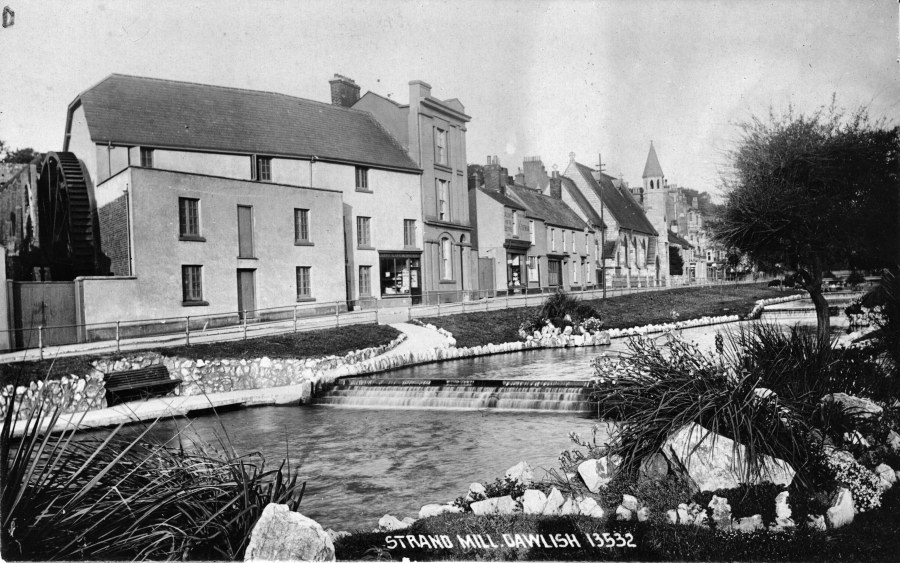
WHEEL AND FORMER MILL
Although now known as Brunswick Place, the area
around the mill was previously called Mill Row. The mill was originally
called Lower Mill but for many years has been known as Strand Mill. The
millpond was situated behind the houses in Plantation Terrace turning
and dropping through a launder to the mill wheel (which was a backshot
wheel) then dropping underground into The Brook.
In 1729 John How was the first miller. He died in 1738 and his widow
continued there. In 1772, we have the name of Richard Reed who ran both
Town and Strand mills. After his death in 1805 his son, Richard Reed
junior, took over but he became bankrupt in 1838. The baking ovens that
he used in his baker’s shop are still in the rear of the mill and were
still in use within living memory.
James Lock took over for thirty-six years from 1890. During his tenancy
the mill suffered an extremely bad fire. The Dawlish Gazette of 8th
February 1910 records that the fire started due to overheated bearings
(a very common occurrence in mills with the dry and dusty conditions)
which quickly spread towards the house but said the fine efforts of the
fire brigade saved the dwelling. However, much later reports said it was
destroyed and had to be rebuilt. During the melee the shop till had been
burgled and some of the rescued furniture had gone missing.
In 1920 the mill was taken over by Torbay Mill Company Ltd which
continued in business offering corn, flour, forage, cake, manure, seed
and even coal, until 1958 when the water to power the wheel was turned
off.
In 1959 Brian Wills leased the premises when the front portion of the
building was used a potato store. He turned it into an upholstery and
flooring business. It passed through many changes such as selling
furniture, fishing tackle, then a general and hardware store, and more
recently, tearooms.
This family then ran the funeral directors business next door for many years.
The launder that brought the water from the leat over the cliff behind
the mill was demolished about 1965, although the working machinery
inside the building is still there with the mill stones in situ
upstairs.
The mill wheel is cast iron, probably replacing an earlier wooden one,
some 33 feet in diameter made by A. Bodley of Exeter and probably
installed by John Dicker of Chagford who seems to have been the region’s
mill engineer.
|
|